In Part I, we covered the trails — where to hike, what to look for, the best timing from the Columbia Gorge to the Bay Area. That article was a field guide. This one is the backstory.
Because behind every wildflower meadow is a web of relationships — between flowers and pollinators, between plants and the people who cultivated them for millennia, between native species and the invaders that are slowly replacing them. The Pacific Northwest and Northern California are not just beautiful wildflower regions. They are ecological dramas playing out in real time, with histories that stretch back thousands of years and futures that depend on what we do next.
Here are the stories the trail signs do not tell you.
🌾 Camas: The Flower That Shaped Civilizations
If you have hiked Mount Pisgah near Eugene or walked through a Willamette Valley prairie in April, you have seen camas. Those fields of blue-purple, star-shaped flowers that carpet low meadows? Those are not decorative. Those are one of the most important food plants in the history of the Pacific Northwest.
For thousands of years, camas bulbs (Camassia quamash) were a dietary staple for Indigenous peoples across the region — the Kalapuya in the Willamette Valley, the Nez Perce in the Columbia Plateau, the Coast Salish in the Puget Sound, and dozens of other nations. The bulbs were harvested in late spring and early summer, then slow-roasted in earth ovens for up to 72 hours. The long cooking converted the bulb’s inulin into fructose, producing a sweet, dense, caramelized food that could be stored, traded, and eaten through the winter.
Camas was not just foraged — it was cultivated. The Kalapuya and other peoples used controlled burns to maintain the open prairies where camas thrives. Fire cleared the brush, enriched the soil, and prevented trees from encroaching. The Willamette Valley that the first European settlers described as a “natural paradise” of open grasslands and wildflower meadows was, in fact, a managed landscape — carefully tended by fire for thousands of years. Without those burns, the valley would have been dense forest.
When European settlement disrupted the burn cycle, the prairies began to close. Today, less than one percent of the Willamette Valley’s original prairie habitat remains. The camas fields you see at Mount Pisgah, at the West Eugene Wetlands, and in scattered preserves across the valley are remnants of a once-vast landscape — beautiful, but a fraction of what existed.
A warning: camas has a deadly look-alike. Death camas (Zigadenus venenosus) grows in the same meadows and looks similar when not in bloom. The flowers are the giveaway — camas blooms blue-purple, death camas blooms white or cream. Never harvest bulbs unless you can identify both plants with certainty.
🦋 The Pollinator Web
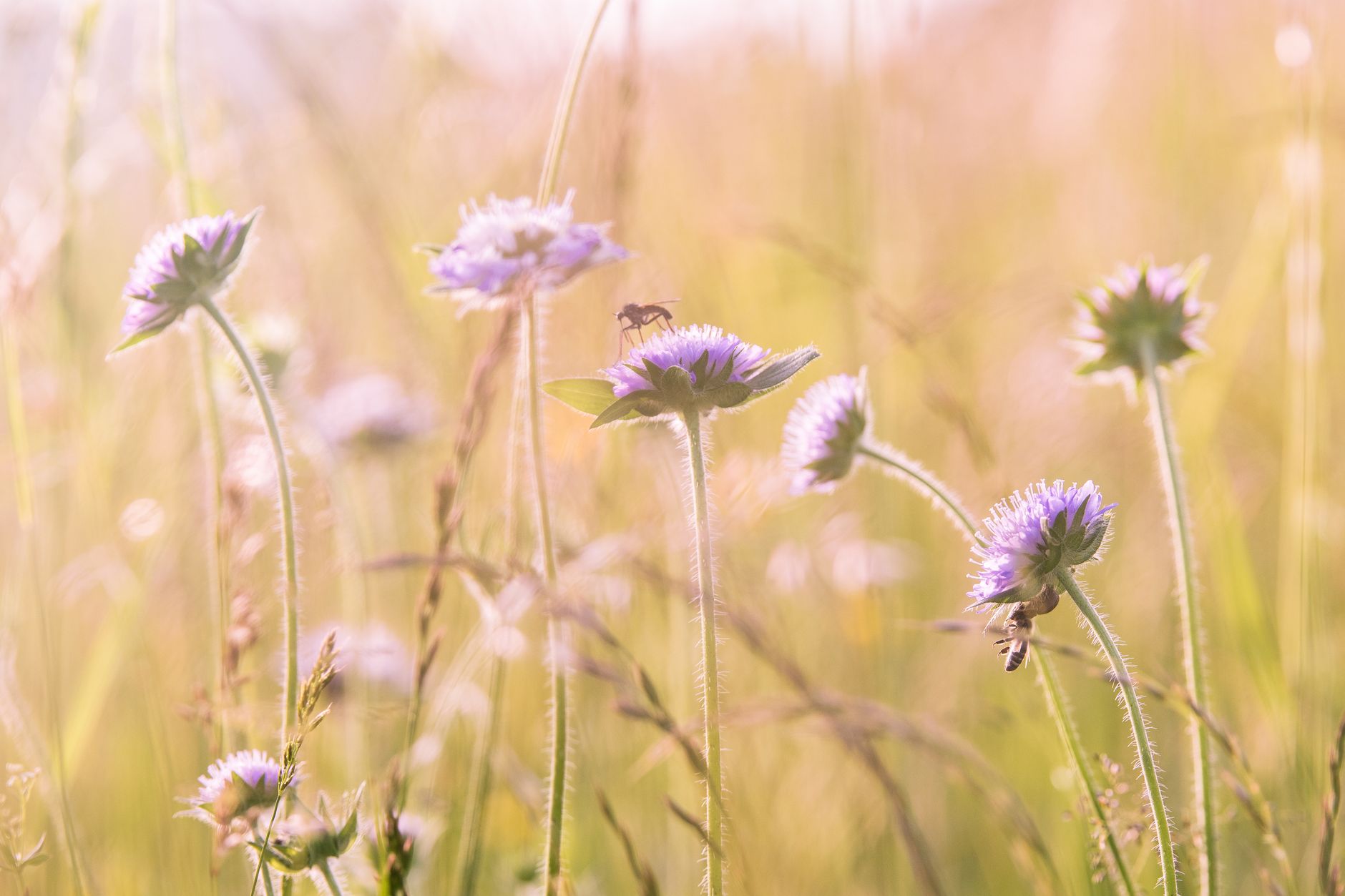
Every wildflower meadow is a cafeteria. The flowers are not blooming for your benefit — they are blooming for the insects, birds, and bats that pollinate them. And those relationships are more specific and more fragile than most people realize.
Oregon silverspot butterfly and the early blue violet. The Oregon silverspot (Speyeria zerene hippolyta) is a federally threatened butterfly found only in a handful of coastal meadows in Oregon and Washington. Its larvae feed exclusively on the early blue violet (Viola adunca). No violet, no butterfly. When coastal meadows are lost to development, Scotch broom invasion, or fire suppression, the violets disappear and the silverspot goes with them. Restoration efforts at sites like Cascade Head on the northern Oregon coast focus specifically on maintaining violet habitat.
Monarch butterflies and milkweed. Monarchs need milkweed (Asclepias species) — it is the only plant their larvae will eat. The Western monarch population, which overwinters along the California coast from Monterey to Santa Cruz, has declined by more than 99 percent since the 1980s. Native milkweed plantings in both Oregon and Northern California are a critical part of the recovery effort. If you grow milkweed at home, you are directly supporting monarch survival. Use narrow-leaf milkweed (A. fascicularis) for California and showy milkweed (A. speciosa) for Oregon.
Anna’s hummingbird and red columbine. The western red columbine (Aquilegia formosa) has long, tubular spurs that are perfectly shaped for hummingbird bills. Anna’s hummingbirds, which are year-round residents from southern Oregon through the Bay Area, are primary pollinators. The red color attracts them (hummingbirds see red better than most insects), and the nectar reward at the bottom of the spur keeps them coming back. It is a flower literally engineered by evolution for one type of visitor.
Native bees and everything else. The Pacific Northwest and Northern California are home to over 600 species of native bees — many of them solitary ground-nesters that most people never notice. These bees pollinate lupine, camas, clarkia, goldfields, and dozens of other wildflowers. They are far more effective pollinators than honeybees for native plants. When you see a wildflower meadow buzzing, much of that buzzing is native bees doing work that the ecosystem depends on.
🌿 Edible Wildflowers of the Region
Some of the wildflowers you walk past on the trail are food. Not all of them — and you should never eat a wildflower you cannot identify with absolute certainty — but the edible ones are fascinating.
- Miner’s lettuce (Claytonia perfoliata) — a succulent, round-leaved green found in shady, moist spots from Oregon to the Bay Area. Gold Rush miners ate it to prevent scurvy (it is rich in vitamin C). The leaves are mild, slightly sweet, and excellent in salads. It grows prolifically in spring and is one of the easiest wild greens to identify.
- Elderflower (Sambucus species) — the creamy white flower clusters of blue elderberry can be battered and fried into fritters, steeped into cordial, or dried for tea. The berries (when ripe and cooked) are also edible. Raw elderberries and all other parts of the plant are mildly toxic. Blue elderberry (S. cerulea) is the safe native species; red elderberry (S. racemosa) should be avoided entirely.
- Wild rose hips (Rosa species) — the fruit of native wild roses, available in fall after the petals drop. Extremely high in vitamin C. Used for tea, jelly, and syrup. The Nootka rose (R. nutkana) is the most common native species in Oregon and Washington.
- Camas bulbs — edible only after extended cooking (see above), and only if you can distinguish them from death camas with complete confidence.
- Nasturtium (Tropaeolum majus) — technically not native (it is a South American garden escapee), but it is naturalized across coastal California and southern Oregon. The flowers, leaves, and seeds are all edible with a peppery, watercress-like flavor. You will find it growing wild along coastal trails, in gardens, and tumbling over fences throughout the Bay Area.
The rule: never harvest wildflowers from public lands, parks, or preserves. Foraging is illegal in most protected areas and harmful to the ecosystem. If you want to eat wildflowers, grow them at home or buy them from a farm.
⚔️ The Invasion
The biggest threat to native wildflowers in our region is not development or climate change (though both matter). It is invasive species — aggressive non-native plants that outcompete natives for space, light, and soil nutrients.
- Scotch broom (Cytisus scoparius) — the bright yellow shrub that lines every highway in western Oregon. It looks cheerful. It is ecological poison. Scotch broom fixes nitrogen in the soil, which sounds good until you realize that most native wildflowers evolved in low-nitrogen soils. Broom changes the soil chemistry, making it inhospitable for natives while favoring more weeds. It also forms dense thickets that shade out everything beneath it. Volunteer broom-pull events happen across Oregon every spring — they are one of the most impactful things you can do for native wildflowers.
- Himalayan blackberry (Rubus armeniacus) — the thorny, impenetrable walls of blackberry that line every creek, vacant lot, and roadside in the Pacific Northwest. The berries are delicious. The plant is a monster. It smothers native understory plants, chokes out riparian habitat, and is nearly impossible to eradicate once established.
- English ivy (Hedera helix) — climbs trees, carpets forest floors, and shades out native ferns, trilliums, and wildflowers. A major problem in urban forests from Portland to the Bay Area.
- Yellow star thistle (Centaurea solstitialis) — a spiny, aggressive annual that has invaded millions of acres of California grasslands. It displaces native wildflowers and is toxic to horses. Once established, it is extraordinarily difficult to remove.
The pattern is the same everywhere: invasives arrive, outcompete, and transform the landscape. Native wildflower meadows become monocultures of broom or blackberry. The pollinators that depended on those native flowers lose their food source. The butterflies, bees, and hummingbirds decline. The whole web frays.
🌱 Growing Native Wildflowers at Home
You do not need a meadow. A corner of a yard, a strip along a fence, or even a few containers on a patio can support native wildflowers — and the pollinators that depend on them.
Seed sources:
- Native Plant Society of Oregon (npsoregon.org) — plant sales, seed swaps, and a directory of native plant nurseries
- California Native Plant Society (cnps.org) — equivalent resource for California, with a nursery finder and Calscape plant database
- Heritage Seedlings (Salem, OR) — wholesale and retail native plants and seeds for the Willamette Valley
- Yerba Buena Nursery (Woodside, CA) — one of the oldest native plant nurseries in California, just minutes from San Carlos
- Cistus Nursery (Portland, OR) — Pacific Northwest native plants and Mediterranean climate-adapted species
How to start:
- Fall sowing is best. Most PNW and NorCal native wildflowers germinate after winter cold stratification. Scatter seeds in October or November, press them into the soil, and let winter rain and cold do the work. Expect germination in March or April.
- Choose species for your zone. Oregon’s Willamette Valley (Zone 8b) and the Bay Area (Zone 9b–10a) have different rainfall patterns and soil types. Use the Calscape database for California and the Oregon Flora Project for Oregon to find species native to your exact area.
- Start small. A 4-by-8-foot patch with three or four native species is enough to attract pollinators and give you a wildflower display by year two.
- Do not fertilize. Most native wildflowers perform best in lean, unfertilized soil. Rich soil encourages weeds and grasses that outcompete the flowers.
💐 Wildflowers in Floral Design
As florists, we get asked: can you put wildflowers in an arrangement? The answer is nuanced.
You should never pick wildflowers from parks, preserves, or public land. It is illegal in most places, harmful to populations, and removes food from pollinators. That said, several native plants are commercially grown and available through wholesale floral supply — or can be sustainably harvested from private land with permission.
Native PNW and NorCal plants commonly used in floral design:
- Salal (Gaultheria shallon) — the glossy, dark-green foliage that appears in arrangements worldwide. Most of the world’s commercial salal is harvested from Pacific Northwest forests. It is the backbone greenery of the cut-flower industry.
- Sword fern (Polystichum munitum) — another PNW native that is a floral design staple. The long, arching fronds add structure and a lush forest feel.
- Oregon grape (Mahonia aquifolium) — the state flower of Oregon. The leathery, holly-like leaves and clusters of yellow flowers (or blue berries in fall) add texture and a distinctly Northwestern character to arrangements.
- Red huckleberry (Vaccinium parvifolium) — delicate, arching branches with tiny leaves. Prized for its airy, natural look in loose, garden-style arrangements.
- Eucalyptus (various species) — not native, but naturalized across California and now one of the most popular greenery choices in floral design worldwide. Seeded eucalyptus, silver dollar eucalyptus, and willow eucalyptus are all California-associated.
When we design arrangements inspired by the PNW or Northern California landscape, we lean on these greenery elements alongside cultivated flowers. The result is something that feels wild and natural without taking anything from the wild.
🌻 Conservation You Can Join
If this article has you wanting to do more than hike, here are ways to help native wildflowers survive:
- Volunteer for invasive removal. SOLVE Oregon (solveoregon.org) organizes broom pulls, ivy removal, and habitat restoration events across the state. In California, the California Invasive Plant Council (cal-ipc.org) coordinates similar efforts.
- Join your local native plant society. The Native Plant Society of Oregon and the California Native Plant Society run field trips, plant sales, and advocacy programs. They are the best way to learn native plants and connect with people who care about them.
- Plant natives at home. Every patch of native wildflowers in a yard, a median, a school garden, or a commercial landscape is habitat. It does not have to be a meadow. It just has to be native.
- Support prairie restoration. In the Willamette Valley, organizations like the Institute for Applied Ecology and the West Eugene Wetlands program are restoring camas prairies and native grasslands. In the Bay Area, the Marin Agricultural Land Trust and Midpeninsula Regional Open Space District manage habitat for native wildflowers.
- Report invasive species. Oregon’s iMapInvasives and California’s Calflora both allow public reporting of invasive plant sightings. Early detection is the cheapest form of control.
🌿 The Meadow Is Not an Accident
The wildflower meadows we hike through are not random. They are the product of millennia of Indigenous land management, centuries of ecological succession, and ongoing battles between native species and invaders. Every camas field is a remnant of a managed landscape. Every lupine hillside is feeding a pollinator web. Every patch of Scotch broom is a battle being lost.
When you walk through a wildflower meadow — whether it is at Mount Pisgah, the Columbia Gorge, Point Reyes, or Mount Tam — you are walking through a story that is still being written. And the flowers you send and receive from your local florist are a small extension of that same relationship between people and plants that has been going on here for thousands of years.
Browse our arrangements, plants, and gifts. We deliver across Oregon and the Bay Area — with greenery that comes from the same forests and landscapes these wildflowers call home. 🌿