
There is a flower that most people think they understand completely. It sits in buckets at the grocery store for $7.99. It shows up in basic spring arrangements between some daisies and a fern. It is the flower you grab when you need something but have not really thought about what. And because of all that, the tulip has become one of the most underestimated flowers on the planet.
Meanwhile, twenty minutes south of your house in Tualatin, there is a 40-acre farm in Woodburn that grows millions of tulips every year in hundreds of varieties — parrot tulips with ruffled petals that look like oil paintings, fringed tulips with crystalline edges, double-bloom tulips as dense as peonies, and color-break tulips streaked with flame patterns that caused a literal financial crisis in the 1600s. The Wooden Shoe Tulip Farm is one of the great tulip destinations in North America, and it is so close to Tualatin that you could go on your lunch break if traffic cooperated.
At tualatinflorist.com, we work with tulips professionally — sourcing them, designing with them, delivering them — and we think the gap between what most people believe about tulips and what tulips actually are is one of the biggest misconceptions in the flower world. This article is our attempt to close that gap.
🏡 The Wooden Shoe Tulip Farm: What It Is and Why It Matters
The Wooden Shoe Tulip Farm sits on 40 acres of rich Willamette Valley soil in Woodburn, Oregon, about 20 miles south of Tualatin via I-5. The farm has been growing tulips commercially since 1950 and has been run by the Iverson family for three generations. Every spring, they open the fields to the public for the Wooden Shoe Tulip Festival, which typically runs from mid-March through early May, depending on bloom timing and weather.
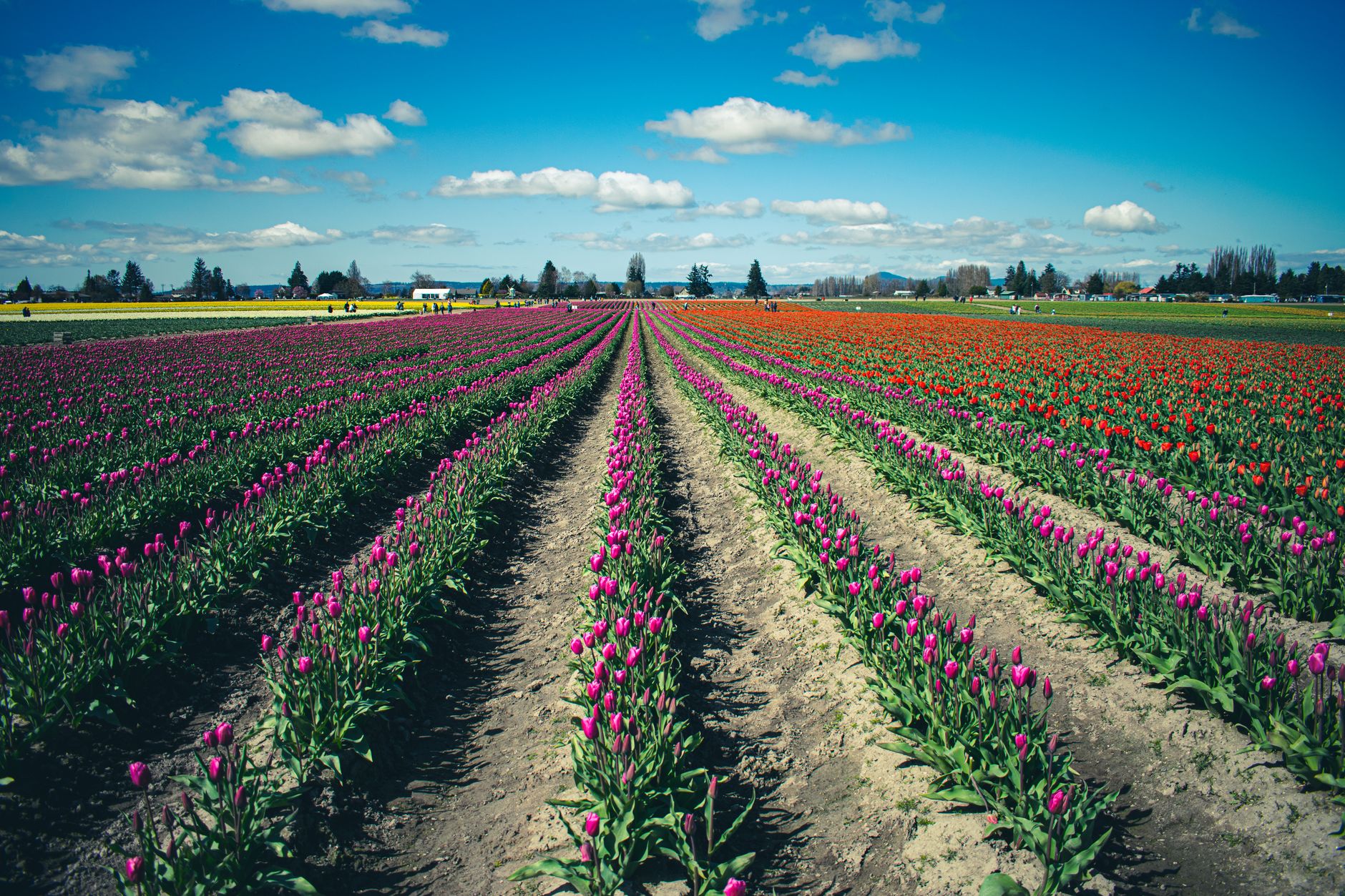
What you see when you arrive is difficult to describe until you have seen it. Row after row of tulips in coordinated color blocks stretching to the tree line — deep reds next to bright yellows next to soft pinks next to pure whites next to streaked bicolors. The fields are planted in long, precise rows that create geometric patterns when viewed from the walking paths, and the whole scene is backed by the foothills of the Cascades. On a clear day, you can see Mount Hood.
The festival includes walking paths through the fields, a wine-tasting tent, food vendors, a play area for kids, and — most importantly for our purposes — a flower market where you can buy fresh-cut tulips by the bunch, directly from the farm. If you have never held a bunch of tulips that were cut that morning from a field you can still see, the experience is genuinely different from anything you have encountered at a store.
Timing note for late April 2026: late-season varieties — the doubles, the parrots, the lily-flowered tulips — are typically at their best from mid-April through early May. If you visit in the next two weeks, you are likely to catch the most interesting and unusual varieties at peak bloom, even as the early singles are fading.
🌎 Why Oregon Grows World-Class Tulips (It’s Not an Accident)
Most people associate tulips with the Netherlands, and for good reason — the Dutch have dominated commercial tulip production for centuries. But the Willamette Valley is one of only a handful of places outside the Netherlands that can grow tulips at a commercial scale, and the reasons are specific:
- The climate is almost identical. Cool, wet winters and mild springs with gradual warming are exactly what tulip bulbs need. The bulbs require a sustained cold period (called vernalization) to trigger blooming, and the Willamette Valley delivers that naturally. Too far south and it is too warm. Too far north and the growing season is too short. Western Oregon is in the sweet spot.
- The soil is exceptional. The valley floor is deep, well-drained alluvial soil deposited by the Missoula Floods thousands of years ago. Tulip bulbs are fussy about drainage — they rot in waterlogged ground — and the Willamette Valley’s soil structure handles that perfectly.
- The photoperiod is right. Tulips are sensitive to day length. The gradual lengthening of spring days at Oregon’s latitude (around 45°N, almost the same as Amsterdam) triggers bloom at exactly the right pace. The flowers open slowly, hold their color, and last longer in the field than they would in a warmer, more abrupt spring.
- The rain cooperates. Spring rain in the valley is gentle and frequent, keeping the soil moist without battering the blooms. By May, the rain tapers off and the bulbs can be lifted and dried for next season.
The result is that Oregon-grown tulips are genuinely premium-quality flowers. The stems are strong, the colors are saturated, and the blooms are large. When we source tulips for arrangements at our shop, Oregon-grown stock is some of the best we can get — and we can get it without it spending three days on a truck from a distant state.
🌸 The Tulips You Have Never Met: Varieties Beyond the Grocery Bucket
Here is where the tulip story gets interesting. The tulip most people know — the single-color, cup-shaped bloom sitting in a cellophane sleeve at the supermarket — is one variety out of more than 3,000 registered cultivars. It is like judging wine by the jug in the bottom shelf. The actual world of tulips is extraordinary:
Parrot tulips. These are the show-stoppers. Parrot tulips have large, deeply ruffled and twisted petals with irregular edges that look like they were painted by hand. Colors are often streaked, feathered, or flamed — deep purple with green edges, red with yellow flames, pink with white streaks. They are dramatic, unusual, and almost always the variety that makes someone say “wait, that is a tulip?” In an arrangement, a few parrot tulips can change the entire character of the design.
Double late tulips (peony tulips). These bloom later in the season and have dense, multi-petaled heads that look remarkably like peonies. They are lush, full, and heavy — a vase of double tulips has a richness that single tulips cannot match. They come in every color from deep burgundy to soft apricot to pure white. If you love peonies but cannot get them yet (peony season starts in late May in Oregon), double tulips are the best stand-in.
Fringed tulips. The petal edges are finely serrated, creating a crystalline or frost-like effect. They catch light differently than smooth-petaled tulips and add texture to arrangements in a way that photographs beautifully. Fringed varieties come in bold colors — deep pink, bright orange, violet — and the fringe is often a slightly different shade than the petal body.
Lily-flowered tulips. Elegant and pointed, with petals that flare outward at the tips like a lily. They are taller and more architectural than standard tulips, and they have a graceful, slightly wild look. In a vase, they lean and curve toward light in ways that give the arrangement a natural, garden-gathered feel.
Viridiflora (green) tulips. These have a distinctive green stripe or flame running through each petal, sometimes on a white background, sometimes on pink or red. They are unusual, sophisticated, and currently very popular in modern floral design. If you want an arrangement that looks different from anything your recipient has seen, green tulips are a florist’s secret weapon.
Rembrandt and broken tulips. The streaked, flame-patterned tulips that caused Tulip Mania in 17th-century Holland — when single bulbs sold for more than houses — were infected with a virus that broke the color into unpredictable streaks. Modern Rembrandt-style tulips are bred to mimic that effect without the virus. They are beautiful, historically significant, and surprisingly rare in everyday flower shops.
At the Wooden Shoe, you can see many of these varieties in the field. At our shop, we can source the best of them for arrangements when they are in season — which is right now.
💡 What a Florist Can Do with Tulips That You Cannot Do at Home
There is a difference between putting tulips in a vase and designing with tulips. Here is what changes when a professional works with them:
- Tulips keep growing after they are cut. Unlike most flowers, tulip stems continue to elongate in the vase — sometimes by several inches. A good florist accounts for this, designing arrangements that accommodate the movement and actually look better as the tulips stretch and curve over the first few days.
- Tulips are phototropic. They bend toward light. This is not a flaw — it is a feature. A skilled arrangement uses that natural lean to create organic shapes and a sense of movement. The tulips on Day 3 look different from Day 1, and both looks are beautiful.
- Mixing varieties creates depth. A mix of parrot, fringed, and single tulips in the same arrangement creates layers of texture that a bunch of identical grocery tulips cannot achieve. Add some lily-flowered tulips for height and a few doubles for density and the effect is genuinely stunning.
- Tulips pair exceptionally well with spring foliage. Tulips with ranunculus, anemones, hellebores, and flowering branches create the quintessential spring arrangement. A florist knows which combinations amplify the tulip’s natural beauty and which clash.
- Color work matters. Tulips come in every color except true blue, and the range within each color is enormous. A florist can build a monochromatic arrangement in five shades of pink tulip that has more visual complexity than a mixed rainbow bouquet.
💰 “But Aren’t Tulips Cheap?”
This is the myth that needs the most work. Yes, basic single-variety tulips in bulk are one of the most affordable flowers at the grocery store. But that is like saying wine is cheap because you can buy a box of it at Costco. The range is enormous:
- Standard single tulips in bulk are affordable and cheerful. They are the workhorses of spring and there is nothing wrong with them.
- Premium varieties — parrots, doubles, fringed, viridiflora — cost significantly more because they are harder to grow, more fragile to ship, and produced in smaller quantities. A bunch of parrot tulips at a farm stand or specialty flower market will cost two to three times what a bunch of standard tulips costs, and the visual difference is dramatic.
- In a professional arrangement, tulips are priced like any other premium seasonal stem. A florist-designed tulip arrangement is not a budget item — it is a seasonal specialty that is available for a limited window and looks unlike anything you can get the rest of the year.
The comparison is not tulips vs. roses. The comparison is good tulips, designed well, in season vs. any flower at any time — and in that comparison, late-April tulips in Oregon hold their own against anything.
🚶 If You Go to the Wooden Shoe: Practical Tips from a Local
If this article convinces you to make the drive, here is what we would tell a friend:
- Go on a weekday if you can. Weekends in peak bloom are beautiful but crowded. A Tuesday or Wednesday morning is the same flowers with a fraction of the people.
- Wear boots or shoes you do not mind getting muddy. The fields are real farm fields. After rain (which is frequent in April), the paths between rows are soft. This is not a paved garden experience.
- Go in the morning. The light is better for photos, the flowers are freshest, and by afternoon on warm days the blooms start to close slightly.
- Buy tulips at the farm market. The fresh-cut bunches are exceptional quality and the prices are fair. Buy a few bunches in different varieties and arrange them at home — or bring them to us and we will design something with them.
- Check the bloom map. The farm typically posts a bloom status page on their website showing which fields are peaking. Late April favors the south fields and the late-season specialty beds.
- Combine it with Wilsonville. The Wooden Shoe is about 15 minutes past Wilsonville on the way to Woodburn. Stop in Wilsonville for lunch on the way back. We wrote a full guide to what to do there.
🌍 A 30-Second History of Tulip Mania (Because You Should Know This)
In the 1630s, the Dutch Republic experienced one of history’s most famous speculative bubbles — Tulip Mania. At the peak, rare tulip bulbs sold for extraordinary sums: a single Semper Augustus bulb reportedly traded for 10,000 guilders, roughly the price of a luxury canal house in Amsterdam. Futures contracts were written on bulbs still in the ground. People mortgaged homes to buy bulbs they had never seen.
The bubble burst in February 1637 and prices collapsed almost overnight. It remains one of the most studied market crashes in economic history — and the flower at the center of it was the tulip.
What caused the frenzy was not ordinary tulips. It was the broken tulips — the ones infected with a mosaic virus that produced unpredictable, unrepeatable color streaks. No two broken tulips looked the same, and the rarest patterns could not be reliably reproduced. It was artificial scarcity combined with genuine beauty, and it drove an entire nation temporarily insane.
The next time someone tells you tulips are basic, you can mention that they once crashed a national economy. Not many flowers have that on their resume.
🌷 The Season Is Short — Order Tulips While You Can
Here is the thing about tulips that makes them different from roses or carnations: they are genuinely seasonal. You can get roses any day of the year. You can get carnations in January and July. But premium tulips — the good ones, the interesting ones, the ones that make people stop and look — are available from roughly late February through early May, and that is it. The window for the late-season specialty varieties (parrots, doubles, fringed) is even shorter: mid-April through the first week of May in most years.
Right now, as you read this, we are in that window. The Oregon-grown tulips are at their best. The variety selection is at its peak. In two or three weeks, the season will be winding down and the premium varieties will be gone until next spring.
At tualatinflorist.com, we deliver fresh, hand-arranged flowers across Tualatin, Sherwood, Lake Oswego, Wilsonville, Tigard, King City, Durham, Stafford, and the surrounding area — same-day when you need it. If you want tulips in your arrangement, now is the time to ask. We can build something seasonal and beautiful around whatever the best tulip varieties are this week.
href="/gifts-occasions" title="Gift Baskets"