
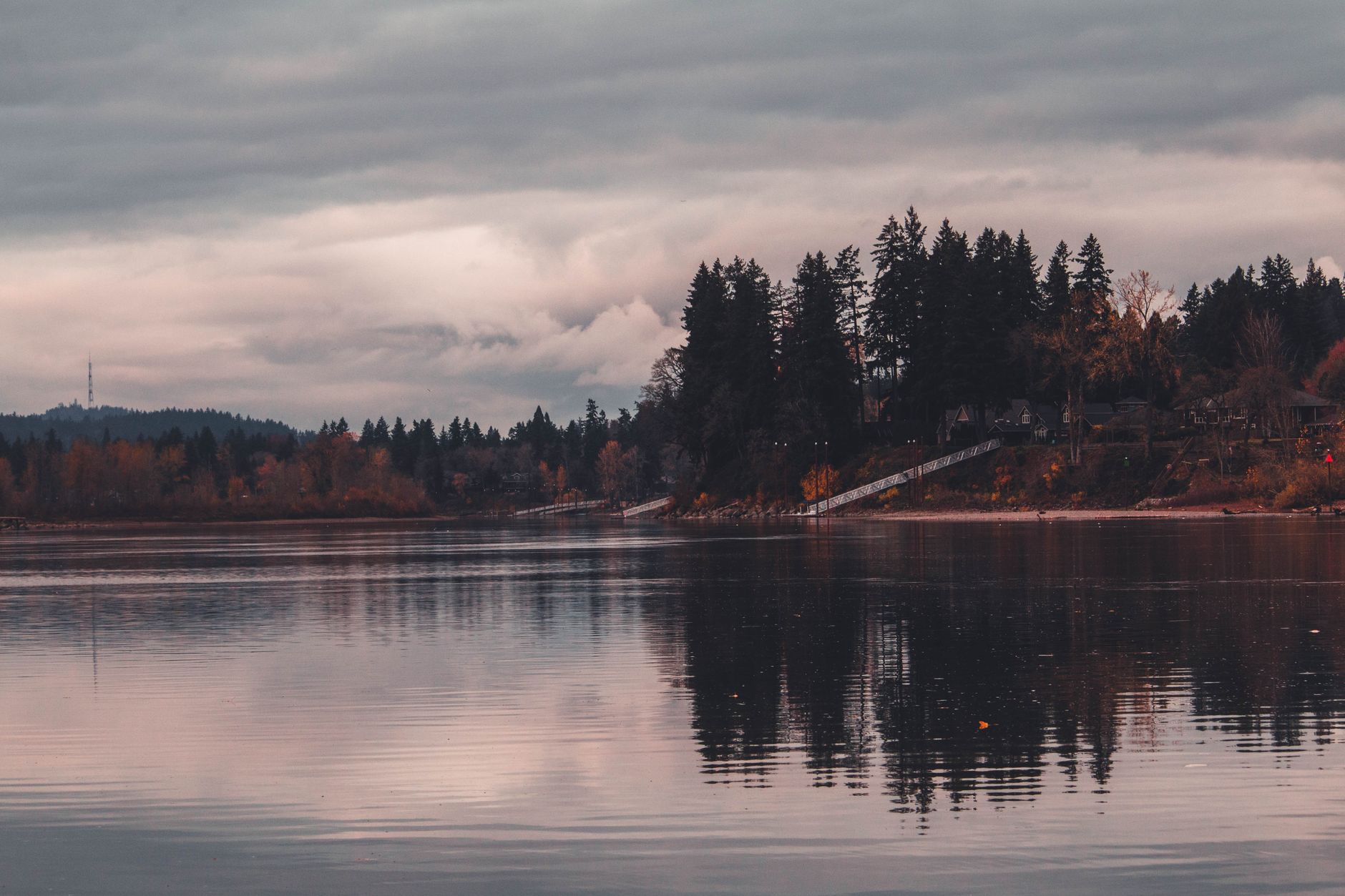
Here is a fact that surprises people who drive between Tualatin and Lake Oswego every week: the two towns are joined by a canal. Water from the Tualatin River flows through the Oswego Canal into Oswego Lake, and the lake itself used to be part of the river. When we say Lake Oswego is our neighbor, we mean it in the plumbing sense as well as the friendly one. We deliver there regularly, and we have written about it before, but we have never told the story of how the two towns fit together. This is that story, with a few good reasons to send each other flowers at the end.
🌊 The River Both Towns Share
The Tualatin River is about 83 miles long. It begins in the Tillamook State Forest in the Coast Range, drains the farm country of the Tualatin Valley west of Portland, and joins the Willamette River near West Linn. It drops from about 2,000 feet above sea level to about 60 feet, and most of that drop happens in the first 15 miles, which explains why the lower river is so slow. The Atfalati people, who lived in the valley, named it with a word that translates as sluggish or lazy. Early settlers called it the “Quality River.” The city of Tualatin takes its name from the river, which runs along most of its northern boundary.
On its way toward the Willamette, the river passes a string of parks, among them Browns Ferry Park and Canal Acres Park. At the east end of Canal Acres Park is the entrance to the Oswego Canal, which carries water from the Tualatin River to Oswego Lake in Lake Oswego. The river that runs along our northern edge is feeding the famous lake next door.
🧊 A Lake That Used to Be a River
Oswego Lake is a former channel of the Tualatin River, carved in basalt toward the Willamette. At some point the river changed course and left the Oswego route behind. Then came the Missoula Floods. About 13,000 to 15,000 years ago, the ice dam holding back Glacial Lake Missoula ruptured and sent floodwater surging down the Columbia, backing it up the Willamette. The flooding created an underwater vortex called a kolk, which scoured out and enlarged the old Oswego channel and made a natural lake.
That same flood flung rocks and boulders as far as a mile away, to what is now Durham and Tualatin. They were quarried for many years, until the site became the Bridgeport Village shopping center. So the next time you are at Bridgeport Village, you are standing where a glacial flood once dropped rocks scoured out of the old channel that became Lake Oswego. Two towns, one flood.
⛵ The Canal and the Sternwheeler
In 1871, the Tualatin River Navigation & Manufacturing Company began work on a continuous waterway that would connect the Tualatin River to the Willamette. The plan called for two canals: one from the Tualatin to the lake, to supply the iron smelter, and a second with locks from the lake to the Willamette through Sucker Creek. The first canal was finished in 1872. Water was low, though, and the first trip through did not happen until January 21, 1873, when the sternwheeler Onward made the passage. That same year the Willamette Falls Locks opened, making it possible for boats to get past the falls, and with the Tualatin hard to navigate anyway, the second canal was abandoned.
The big picture is a failed shipping route that turned into a permanent water supply. A canal built for sternwheelers ended up feeding a lake, and more than 150 years later it is still doing that.
🏠 Two Origin Stories
The two towns started very differently.
Lake Oswego began as a sawmill town. Albert Alonzo Durham built a sawmill on Sucker Creek in 1847 and, in 1850, made the area’s first Donation Land Claim, which he named Oswego after Oswego, New York. The lake itself was called Sucker Lake, for a fish that was abundant there, until the community decided the name did not appeal to potential residents. In 1913 it was officially renamed Oswego Lake. Meanwhile the town had a brief, loud career in iron. The Oregon Iron Company was incorporated in 1865 to smelt the local iron ore, and within two years it had built the first blast furnace on the West Coast. Promoters dreamed of making Oswego the “Pittsburgh of the West.” Production peaked around 1890, when the industry employed about 300 men, and then cheaper iron from the Great Lakes region ended the dream.
What came next was the commuter town. A railroad reached Oswego in 1886, and in 1914 the line was electrified and became the Red Electric, which ran as many as 64 trains a day to Portland at its 1920 peak. Oswego incorporated in 1910, and in 1960 it annexed part of neighboring Lake Grove and took the name Lake Oswego. The Willamette Shore Trolley still runs on part of that old line.
Tualatin started with a bridge. The settlement was first called Galbreath, after Samuel Galbreath, who built the first bridge across the Tualatin River in 1853, and the town became known as Bridgeport. In the 1880s John Sweek platted a town around the new railroad depot and named it Tualatin. It was incorporated as the City of Tualatin in 1913. A post office spelled “Tualitin” opened in 1869, and the spelling changed to “Tualatin” in 1915. Fossils turn up here too: in 1962 a mastodon was excavated in what later became a parking lot, and it is on display in the lobby of the Tualatin Public Library.
So one of us began as an iron-and-lumber town reborn as a lake suburb, and the other began as a bridge and a railroad depot. Each has a river story. They end up in the same place anyway, about a short drive apart.
🔢 Side by Side
At the 2020 census, Lake Oswego had 40,731 residents and Tualatin had 27,942. Lake Oswego’s median age was 47.3, and Tualatin’s was 37.5. Lake Oswego surrounds a lake of more than 400 acres; Tualatin has the river running along its northern edge. The occasions are the same either way: birthdays, anniversaries, thank-yous, get-wells and goodbyes, and the flowers are too.
👯 Alike and Different
For two towns that people tend to describe as opposites, they have a lot in common.
- Both are named for water. Tualatin takes its name from the river, and Lake Oswego from the lake.
- Both began as pioneer settlements. Oswego was founded in 1847, and the settlement that became Tualatin appeared in the 1850s as Galbreath, then Bridgeport.
- Both grew up around a railroad in the 1880s. The railroad reached Oswego in 1886, and Tualatin was platted around its railroad depot in the 1880s.
- Both incorporated within three years of each other. Oswego in 1910, Tualatin in 1913.
- Both are Portland suburbs that straddle county lines. Tualatin is mostly in Washington County with a small part in Clackamas County, while Lake Oswego is mostly in Clackamas County with small portions in Multnomah and Washington counties.
And then the differences. One town is built around a lake and the other along a river. One grew from iron and lumber, the other from a bridge and a depot. One is bigger and older on average. If you want the short version, Lake Oswego has the lake and Tualatin has the river, and both are happy with that trade.
🛣️ The Road Between
Any local can tell you that Boones Ferry Road is a major route through the south metro. The name goes back to a cable ferry that crossed the Willamette River at present-day Wilsonville from 1847 to 1954. Alphonso Boone’s family built it, and the ferry was part of the main land route linking young Portland with the pre-territorial government at Champoeg and later Salem. Many sections of that old road are still in use, named Boones Ferry Road, closely paralleling Interstate 5. Every time you drive it, you are following a pioneer route.
🚦 Two Towns, Two Highways
The towns sit on different roads, which is part of why they can feel like separate worlds. Interstate 5 runs through Tualatin. It crosses the Tualatin River into Durham, passes Bridgeport Village, and then enters Tigard. Lake Oswego’s main highway runs along the Willamette instead. Oregon Route 43 enters the city from the south as Pacific Highway, crosses Oswego Creek, passes through downtown, and then climbs along the river as South Riverside Drive. That road was once the original route of U.S. Route 99 in the south Portland area.
Lake Oswego also has a rail line of its own. The Willamette Shore Trolley, a heritage railroad, runs 5.5 miles between Portland and Lake Oswego on the old line, including a passage through the quarter-mile Elk Rock Tunnel. Its Lake Oswego terminal is downtown, alongside State Street just south of A Avenue. It normally runs on weekends from Memorial Day through Labor Day, with a few special runs at Christmas.
💧 The Lake That Gets Lowered
One more odd fact about our neighbor: every three years or so, the water level in Oswego Lake is lowered several feet by opening the gates on the dam, so lakefront owners can repair docks and boathouses. In 2010 the lake was lowered about 24 feet to allow a new sewer line, the lowest level since 1962. In a lowering year, a lot of people suddenly spend a lot of time looking at the bottom of their own back yards. We have no flower-based fix for that, but a bouquet for a neighbor who is dealing with the dock is never a bad idea.
💐 What Good Neighbors Send Each Other
- A housewarming bouquet. New to the lake? A bouquet that arrives on the first weekend says welcome better than a card. Our guide to what to bring when you are invited to someone’s house covers the etiquette.
- A thank-you for the neighborly favor. The one who took in the packages, brought the casserole or kept an eye on the house. Flowers are the right size for a thank-you that does not need to turn into a debt.
- A dinner-party arrangement. The lake has a lot of dinner parties. Keep the arrangement low enough to see over, and choose lighter scent for the table.
- A care package of calm. For someone recovering or grieving, a thoughtful bouquet from the next town over reads as someone who knows the neighborhood. See our local guide to sympathy flowers.
- Just because. The least obvious and the best. A bouquet on an ordinary Tuesday is the kind of thing neighbors talk about.
📬 Sending Flowers to Lake Oswego From Tualatin
If you are on the Tualatin side and sending to someone on the lake, or the other way around, our Lake Oswego delivery page covers the neighborhoods we deliver to, from downtown and Lake Grove to Lakewood and Mountain Park, along with answers to the common questions. Lakewood Bay, one of the lake’s inlets, was created in 1928 when a marshy area called the Duck Pond was flooded and connected to the main lake, which allowed more shoreline homes to be built. When you order, give us the full address, a gate code if there is one, and a phone number for the recipient. We deliver seven days a week.
🚶 Keep Exploring the Neighborhood
If this made you curious about the area between our two towns, we have more. Our guide to Lake Oswego’s walks, eats and weekend escapes is the friendly tour, and our local guide to sending flowers in Lake Oswego covers the neighborhoods. For the small communities nobody outside the south metro can name, see Rivergrove, Lake Grove and the small communities around Lake Oswego, and for the quiet land between us and West Linn, there is the Stafford Triangle. And if you want a laugh, our spicy opinions, Lake Oswego edition, is the friendly teasing a neighbor earns.
📋 The Short Version
- The Tualatin River runs along Tualatin’s northern edge. The Oswego Canal carries its water into Oswego Lake, and the lake itself is a former channel of the river.
- The Missoula Floods carved the lake and threw boulders to Durham and Tualatin, which were quarried until Bridgeport Village was built.
- A canal finished in 1872 was meant for sternwheelers and now feeds the lake.
- Lake Oswego began as a sawmill and iron town, renamed itself in 1960, and has 40,731 residents. Tualatin began with a bridge in 1853, incorporated in 1913, and has 27,942.
- The lake is lowered every few years for dock repairs. In 2010 it dropped about 24 feet.
- The towns share more than you would think: both are named for water, began as pioneer settlements, got railroads in the 1880s and incorporated three years apart.
- They sit on different highways: Interstate 5 through Tualatin, Oregon Route 43 along the Willamette through Lake Oswego.
- Neighbors send flowers for housewarmings, favors, dinners, hard weeks and no reason at all.