
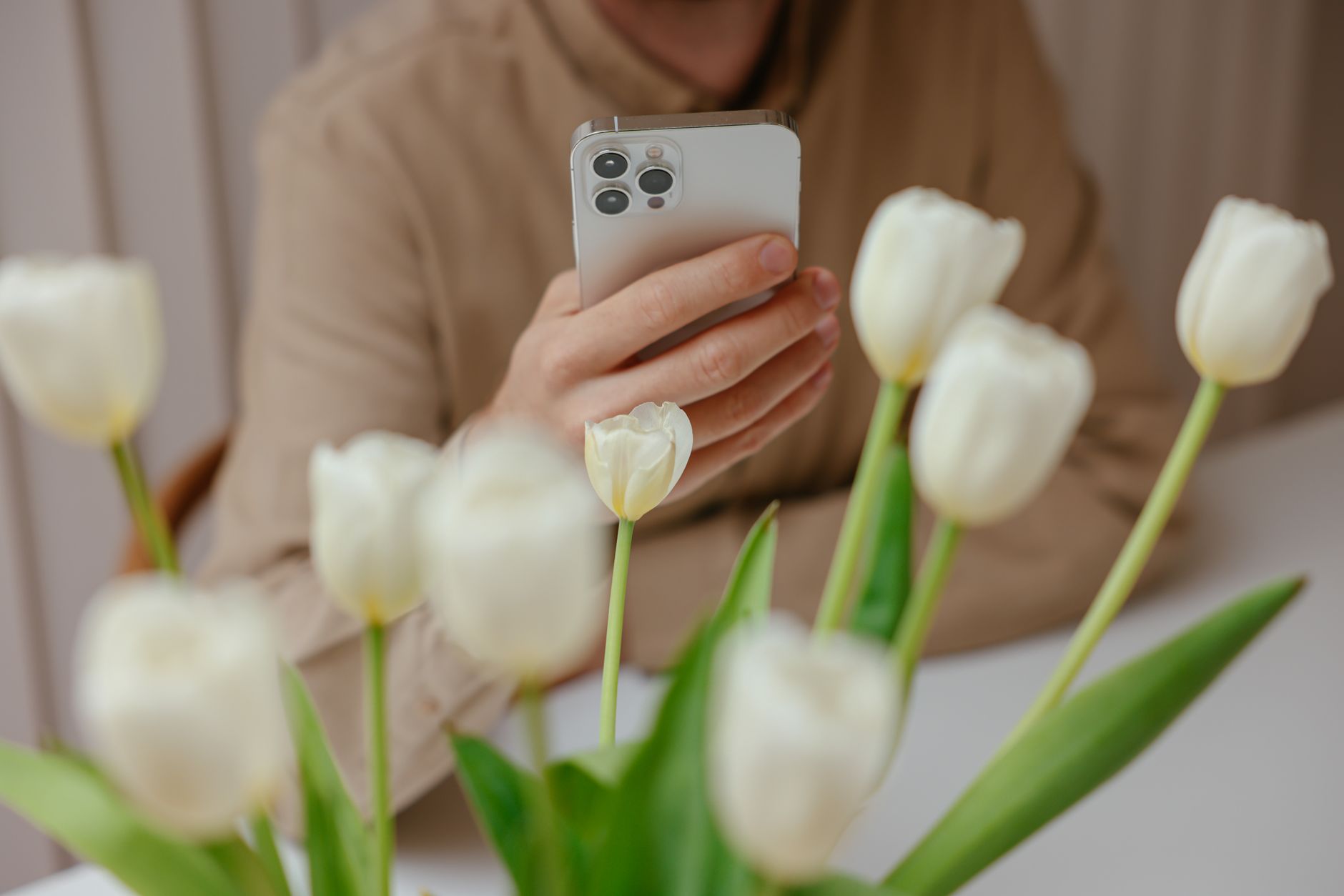
Someone sends you a beautiful arrangement. Or you pick one up from a florist. Or you grow something stunning in your garden. You pull out your phone, take a photo, look at it, and think: “Why does this look so much worse than it does in real life?”
It is not your phone. It is not the flowers. It is almost certainly the lighting, the angle, or the background — the three things that separate a gorgeous flower photo from a flat, dull, forgettable one. And all three are fixable in about 10 seconds without any equipment, any apps, or any photography experience.
We photograph flowers every day for our website, our records, and our own satisfaction. Here is everything we have learned, distilled into the simplest possible guide.
💡 Rule #1: Turn Off the Overhead Lights
This single change will improve 80% of flower photos immediately.
Overhead lights — kitchen ceiling fixtures, fluorescent tubes, recessed cans — cast downward shadows, yellow or blue color casts, and flat, unflattering light onto flowers. They make reds look orange, whites look yellow, and purples look muddy. They erase the delicate shadow and depth that makes a real arrangement look three-dimensional.
The fix: Turn off every artificial light in the room. Move the arrangement to a window. Use only natural light. That is it. One change, massive improvement.
☀️ Natural Light: The Only Light You Need
Natural window light is the single most important factor in flower photography. Here is how to use it:
- Place the arrangement near a window — within 2–4 feet. The closer to the window, the softer and more directional the light.
- Indirect light is best. A north-facing window or a window with sheer curtains provides soft, even illumination without harsh shadows. Direct sunlight creates bright spots and deep shadows that confuse your phone’s camera.
- Morning light is warmest. East-facing windows in the morning produce a golden, warm light that makes warm-toned flowers (reds, oranges, yellows, pinks) glow. Afternoon west-facing light can be too harsh and orange.
- Overcast days are perfect. Cloud cover is nature’s softbox. If it is cloudy outside, every window in your house becomes a professional light source.
The test: Hold your hand near the arrangement. If you see a soft, gradual shadow on one side — that is good light. If you see a hard, dark shadow with a bright edge — the light is too direct. Move the flowers further from the window or wait for a cloud.
📐 The Three Angles That Always Work
Most people photograph flowers from whatever angle they happen to be standing at. That is why most flower photos look like surveillance footage. Choose one of these three intentional angles instead:
1. The 45-degree angle (classic): Hold your phone at roughly 45 degrees above the arrangement, looking slightly down at it. This is the most natural, flattering angle for most arrangements because it shows both the top of the flowers AND the shape/height of the design. This is what your eye naturally sees when you look at flowers on a table. It feels familiar and beautiful.
2. Directly above (flat lay): Hold your phone directly over the arrangement, pointing straight down. This works best for round, compact arrangements where the top is the most interesting view — garden roses, dahlias, dense mixed bouquets. It does NOT work well for tall, spiky arrangements (the height is invisible from above).
3. Eye level (dramatic): Get low. Hold your phone at the same height as the arrangement and shoot straight across. This creates a dramatic, editorial look that emphasizes height, structure, and the silhouette of stems and blooms against the background. Works beautifully for single stems, tall arrangements, and flowers in interesting vases.
The rule: If you are not sure which angle to use, try all three. It takes 10 seconds. One of them will obviously be better than the others, and it is different for every arrangement.
🎨 Background: Less Is Everything
The number one background mistake: too much stuff in the frame. The toaster, the coffee maker, the stack of mail, the kids’ homework, the half-empty glass of water. Your brain filters these out when you look at flowers in real life. Your phone’s camera captures every single one of them, and they compete with the flowers for attention.
Good backgrounds:
- A clean, solid-colored wall (white, cream, light gray, soft blue)
- A wooden table with nothing else on it
- A marble or stone countertop, cleared
- A plain tablecloth or linen napkin spread behind the arrangement
- An out-of-focus window (the blur creates a soft, luminous backdrop)
The 5-second rule: Before you take the photo, spend 5 seconds looking at everything in the frame that is NOT the flowers. Move it, hide it, or reframe to exclude it. The flowers should be the only interesting thing in the image.
💧 The Water Droplet Trick
This is the single easiest trick that makes any flower photo look magazine-quality:
Mist the petals with water. Use a spray bottle, or just flick water droplets onto the blooms with your fingers. Tiny water droplets on petals catch light, add dimension, create the illusion of freshness, and make colors appear deeper and more saturated.
Every professional flower photographer does this. Every florist website photo has misted petals. Now you know the secret. A $3 spray bottle from the hardware store is your best flower photography tool.
📱 Phone Settings That Help
- Portrait mode: Use it. Portrait mode blurs the background and keeps the flowers sharp, which immediately creates a professional-looking depth effect. It works especially well at the 45-degree and eye-level angles.
- Tap to focus: Tap your screen on the specific flower you want to be sharpest. Your phone will focus on that point and adjust the exposure for that area. Tap the most interesting bloom — the fullest rose, the brightest gerbera, the most open peony.
- Exposure adjustment: After tapping to focus, slide your finger up or down (iPhone) or use the brightness slider (Android) to brighten or darken the image. Flowers almost always look better slightly brighter than your phone’s automatic exposure. Slide up just a touch.
- Clean your lens. Your phone lives in your pocket or purse. The lens has fingerprints on it. Wipe it with your shirt before shooting. This alone removes the hazy, soft look that plagues many photos.
🚫 What NOT to Do
- Never use flash. Phone flash creates harsh, flat, unflattering light that washes out petal color and creates ugly shadows behind the arrangement. If you do not have enough natural light, move the flowers closer to a window. Do not use flash.
- Do not use heavy filters that change petal colors. A rose that is coral in real life should not look neon pink in your photo. Subtle brightness and contrast adjustments are fine. Color-shifting filters misrepresent the flowers.
- Do not zoom digitally. Move your body closer to the flowers instead of pinching to zoom. Digital zoom degrades image quality. Physical proximity does not.
- Do not photograph from below (looking up). The underside of a flower arrangement is not its best angle. You see stems, mechanics, and the bottom of the vase. Unless you are going for an intentionally artistic shot, stay at eye level or above.
- Do not wait too long. Flowers look their best on days 1–3. By day 5, petals are dropping, colors are fading, and leaves are wilting. Photograph your flowers when they arrive, not when they are past their peak.
🌸 Quick-Reference Cheat Sheet
- Turn off overhead lights
- Move flowers to a window (indirect natural light)
- Clear the background of clutter
- Mist the petals with water droplets
- Clean your phone lens
- Choose your angle: 45°, overhead, or eye-level
- Tap the focal flower to focus
- Slide exposure up slightly (brighter)
- Use portrait mode for background blur
- Take 5–10 shots and pick the best one
Ten steps. Ten seconds each. The difference between a forgettable photo and one you actually want to keep is less than two minutes of intention.
🌿 Why This Matters
A flower arrangement is a temporary thing. It lives for 5–10 days and then it is gone. A photograph is the only version of it that lasts. The arrangement your florist built — the delivery driver who brought it to your door, the designer who chose every stem, the person who sent it with a card message they agonized over — all of that effort exists in the real world for a week. A good photo lets it exist forever.
Your flowers deserve a good photo. Now you know how to take one. 📸
Browse our arrangements, plants, and gifts. Same-day delivery available. And when they arrive — turn off the overhead lights, find a window, and get the shot.